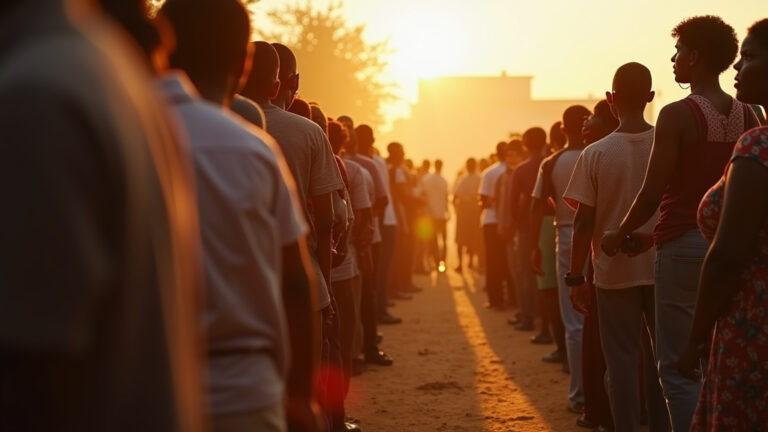
There is good reason why the rural vote matters a great deal to Zanu PF. For the same reason, it should matter more to the opposition and they must pay particular attention to it. Until the opposition gains ground in the rural areas, Zanu PF will always occupy a position of advantage in elections.

It is important, therefore, to understand why Zanu PF is stronger in rural areas and more importantly, the ways through which Zanu PF uses and maximises on the critical rural vote.  The line between legality and illegality of these ways is very thin, and it also shows the complex nature of the reforms being demanded by the opposition.  As this article demonstrates, Zanu PF’js control of the rural vote is yet another illustration of the sophistication with which The System operates in Zimbabwean politics.
Rural-Urban Divide
Zanu PF, more than any other party, knows the critical significance of the rural vote because that is where the bulk of the population and the electorate live. Census data (2012) showed that Zimbabwe has a population of 13 million people. Of these, 67% are in the rural areas, leaving the remainder (33%) in the urban areas. This means more than two-thirds of the population lives in rural areas.

These rural areas include communal lands, resettlement areas and farming areas. Traditionally, going back to the days of the liberation struggle, Zanu PF has always drawn the bulk of its support from the rural areas. Naturally, given the fact that rural areas host large numbers of Zimbabweans, this gives it an advantage over other competitors.
The MDC’s strongholds on the other hand have been in the urban areas, which is not surprising because the party was built on the foundation of the labour movement, most of whose members were based in urban areas. A large chunk of its rural support would have been the thousands of commercial farmworkers. However, with the decimation of commercial agriculture over the last 15 years, the local farming population has dissipated and dwindled over the years, taking away an important source of its rural support. In any event, exclusionary citizenship laws passed in 2002, which banned dual citizenship affected the bulk of former commercial farmworkers whose parents had originated from neighbouring countries like Malawi and Mozambique. Being regarded as non-citizens of Zimbabwe, they were effectively disenfranchised.
While in 2008, the MDC did much better in the rural areas than previously, winning more seats in predominantly rural constituencies such as Masvingo and Manicaland, there were serious reversals in 2013 elections. The MDC raised significant concerns over the 2013 elections, alleging massive vote rigging. However it is also important to note that while the MDC won more seats in the 2008 parliamentary elections, Zanu PF still had the edge on the popular vote. Zanu-PF won 45,94% of the votes, MDC-T got 42,88% the MDC-N won 8,39% and the rest earned 2,79%. Zanu PF’s greater votes on the popular vote could be explained by its dominance in the rural constituencies.
In this regard, Masvingo gave an interesting picture, showing a marked difference between the number of seats won by parties compared to their provincial vote. With 52,01% of the votes, Zanu-PF won the popular vote in Masvingo, beating its main rival the MDC-T into second place with 41,61% of the vote. However, when it came to seat distribution, Zanu PF only managed to win 12 seats and at 14 the MDC-T had more seats. This can be explained by Zanu PF’s dominance among rural voters in Masvingo so that where they won in a rural constituency, it was with a greater margin than a respective loss in an urban constituency.
Opposition parties cannot afford to ignore these numbers. They need to observe the pattern, especially in rural constituencies. A preliminary assessment shows that Zanu PF has always had an edge in the rural areas. This means apart from rigging, there is a core constituency of voters that always backs Zanu PF and this is usually in the rural areas, where the majority live. While they rightly seek electoral reforms, the opposition must not lose sight of the big challenge of how to penetrate these Zanu PF strongholds. Â Their demands for electoral reforms must not obfuscate the important task of formulating strategies to win the rural vote, which is critical.
Â
Registered Voters
The second critical feature of rural areas for electoral purposes, compared to urban areas, is that the rates of voter registration are much higher in rural areas than in their urban counterparts. Analysis of the voters’ roll by the elections NGO, the Zimbabwe Election Support Network (ZESN) just before the 2013 elections demonstrated that 99.7% of the eligible rural population were registered compared to just 67% of the eligible urban population. This further confirms the point that there are more rural than there are urban voters.
In addition, a gender audit of the voters’ roll by the Research Advocacy Unit (RAU) in 2013 showed greater rates of voter registration among rural women than their urban counterparts. Whereas the voter registration rates among women in the metropolitan areas of Harare and Bulawayo were 63% and 73% respectively, the rates in the predominantly rural provinces of Mashonaland Central, Mashonaland East, Manicaland, Matabeleland North, Matabeleland South and the Midlands were upwards of 90%. This echoes similar views that the majority of voters are in the rural areas.
Furthermore, research by the RAU and The Women’s Trust (TWT) (2014) shows that older women in rural areas are more likely to be registered voters and to have voted in previous elections. In other words, they are consistent and regular voters. All these figures suggest a greater tilt towards the rural vote, which traditionally has been Zanu PF’s source of support and naturally, this places it in a position of advantage.
It means that the opposition, which normally draws its support from the urban areas must not only work to increase their appeal among the rural people, but that they must also maximise on their natural strongholds by promoting higher rates of voter registration in urban areas. There are reasons why less urban women are registered than their rural counterparts. Big political rallies in urban areas may do much to boost political egos, but they add little if the people attending are not registered to vote. One of the biggest priorities must be to encourage voter registration. Zanu PF is taking advantage of by-elections to get its supporters to register as voters. If the MDC lulls itself into inaction through the election boycott, Zanu PF will have opened a huge gap by the time 2018 arrives. The 2013 experience shows that it’s never a good idea to wait until the last minutes to get people registered. The opposition needs to engage ZEC and ensure voter registration is taking place continuously, as it should.
Perceptions on Elections
Research carried out by the RAU and the TWT (2014) has some interesting insights on the views and perceptions of rural women compared to urban women in respect of elections. It is important to note that women constitute a very important and perhaps the most active component, alongside the youths, of political party activities and electoral politics. Research by RAU in 2010 had already shown that women see participation in politics as important and that they often did participate as voters. We have already seen that there are higher rates of voter registration among rural women and that they are a critical part of the regular voting population. It is important therefore, to understand their views and perceptions regarding elections.
 Research by RAU and TWT showed that compared to their urban counterparts, rural women, especially the older ones, felt overwhelmingly that elections were free and fair. They had witnessed some irregularities, such as violence against women, but still more rural women felt that the elections were well-run. It is important for political actors to understand this phenomenon because it goes counter to the commonly held view that most Zimbabweans believe elections are not free and fair and therefore understand the opposition’s concerns when they cry foul or call for election boycotts.  For example, the Afrobarometer Survey results (2015) demonstrate that while 46% of adult Zimbabweans do not trust the Zimbabwe Electoral Commission (ZEC), there is a marked difference in opinion by location. The results show that while ZEC is trusted by only 33% of the urban population, it enjoys trust from 54% of the rural population.  This suggests that commonly-held perceptions of ZEC’s unfairness are not necessarily shared by the majority of rural dwellers.
If this research is to be believed, and these are credible research organisations that have no reason to be anti-opposition, it suggests that the opposition needs to have a better understanding of the views of the population in the rural areas because what they think they know may not necessarily be accurate. Surveys are commonly dismissed on the basis that people are fearful and that they do not always give correct answers for fear of victimisation. This may be true, but it is also important not to overplay the card of fear and to permit it to obfuscate otherwise valid observations.
Assisted Voters
Research by ZESN following the 2013 elections demonstrated that there were 25 or more assisted voters at 38% of all polling stations around the country. Of these, the larger numbers were in rural areas. The same data showed that there were 25 or more assisted voters at 49% of all polling stations in the rural constituencies. By comparison the figure for urban constituencies was on 5%. This suggests that the phenomenon of assisted voting was more prevalent in rural areas than in urban areas. It means there were more assisted voters in rural areas, where Zanu PF draws its greatest support.
The fear for the opposition is that assisted voting is easily manipulated as people are organised and marshalled to vote with the assistance of designated persons. As we will observe shortly, this is a very stealthy form of election manipulation because the law does not prohibit assisted voting. It allows a person to select a person of his choice to assist him to vote. But this can be easily manipulated in close-knit rural communities and this leads us to the next important feature of rural communities which make them highly susceptible to manipulation.
Traditional Leadership

Traditional leaders are dominant and important feature of rural life. They have many powers, including allocation of land, exercising discipline, resolution of disputes, provision of state-based welfare support and relief. They have powers emanating from the modern state structures but also, more importantly, from the traditional cultural sources. They therefore command the respect of and instil fear among people under their jurisdiction. Because of their role, they have always been manipulated by the state, both in colonial and post-independence periods. Indeed, many chiefs were criticised as puppets of the colonial government, but after independence, the Zanu PF government has used traditional leadership institutions in much the same way.
They do so because traditional leadership institutions in rural areas are critical instruments of social and political control. They operate a tight command and control hierarchical system organised on the basis of traditional authority, which is respected and obeyed by members of the community. Recent research by Afrobarometer shows that traditional leaders are trusted by nearly two-thirds of the adult population (64%). Critics might argue that this is, in fact, fear but it really does not make a difference because what it all boils down to is that members of the community obey the commands of traditional leaders.
This is important because traditional leaders act as an instrument of Zanu PF during elections. They are the ones who organise voters and provide the “assistance†to voters. Members of the community know the consequences of disobeying the chief or headman, and they have no choice but to accept the “assistanceâ€. People are simply told that they will be assisted by X and when they get to the polling station, they will declare, as if it were voluntary, that they want X to assist them. Polling officers have no way of knowing that there is duress or undue influence being exerted upon the voters.
The combination of the power and influence of traditional leaders and assisted voting means Zanu PF has a massive advantage over its competitors. Reading this, one can appreciate the challenge faced by those who are calling for election reforms. These are not paper-based reforms. Rather, there are reforms in respect of the actual practice in the conduct of elections.
Access to welfare
Zanu PF maximises on its power to control access to state support in rural areas, which are generally impoverished. Poverty in rural areas has created a population that is perennially dependent upon state and donor support. Both state and donor support are politically repackaged as support from President Mugabe and Zanu PF. Support includes grain, agricultural inputs like seed and fertiliser.
The Zanu PF government has systematically repackaged welfare support to rural communities into an effective instrument of political control and manipulation. This is achieved by using exclusionary means in allocating support, so that only Zanu PF supporters benefit while opposition supporters are sidelined. Naturally, the instinct for self-preservation kicks in and opposition supporters have to toe the line. This system is enforced and monitored by traditional leaders and local authority leaders at the district and provincial levels most of whom answer to Zanu PF.
Land narratives
Â
Few things matter to rural communities than land and the capacity to utilise it. They are dependent on the land and the majority of them are poor peasants. The message of land reform appeals to them more than any other segment of the population.  The land reform programme may have been chaotic and it may have come at great cost to commercial agriculture and the economy, but most rural people understand and appreciate it. Indeed, thousands of peasants benefited from the pieces of land that were handed out by government. It does not matter that this land is probably not being put to maximum usage or that the thousands of farmers have not received title or support. The fact that they have land is much appreciated among them.
Politically, they credit President Mugabe and Zanu PF for the land and the message has been drummed into them to believe that the MDC is a real threat to their newly-acquired land. It doesn’t help the MDC that they were publicly supported by displaced white commercial farmers in the early years. It only fed into the propaganda that the MDC had been formed by the white farmers and that it would take back the land and return it to the whites if ever they got into power.  This propaganda has been effective, especially in the resettlement areas, where most of the beneficiaries of the land reform program reside. These areas are almost exclusively dominated by Zanu PF, with clear structures that ensure that they all vote for Zanu PF during elections.
The opposition has tried, albeit unsuccessfully, to construct a new narrative around the land issue. Zanu PF’s message on land reform seems to have always been more superior and harder to contest. If the opposition are to make any in-roads in these rural communities, especially in the resettlement areas, they would have to construct new, attractive and persuasive narratives around land which appeal to these people. Otherwise this will remain exclusively Zanu PF territory, and it’s not small.
Violence, fear and the liberation narrative
Most Zimbabwean elections since independence in 1980 have been characterised by violence and much of it is concentrated in the rural areas. There is a long history of political violence in rural areas, dating back to the days of the liberation war. Much of the war was concentrated in the rural areas and people who are now in the 50s and above witnessed first – hand the effects of violence. Many younger ones have witnessed sordid acts of violence during elections, especially in 2008. 2013 was better but the damage had already been done. The memory of previous violence was enough to remind people of the consequences of not keeping in line. There are enough systems of protection against violence and intimidation in rural areas. If anything, one could even say violence is institutionalised in much of the country, even more so in rural areas. It is precisely for this reason that polling-station based voters’ rolls have been seen as a problem. While they can help to prevent multiple voting, the risk for voters is that voting patterns according to wards will be easily identifiable in such a system. The problem of violence is enhanced by the phenomenon of militarisation of civilian institutions – which is a national problem. Of particular importance in rural areas are the militia – who are not part of the military but act as an auxiliary fore for Zanu PF, particularly during election times. A video was shown recently, showing Zanu PF Secretary for Administration Ignatius Chombo introducing these militia-types to rural voters in the Hurungwe West by-election. Their job, as he explained, was to ‘protect’ village heads, but in reality their role was to monitor their activities, to ensure they were not mobilising for the rival candidate Temba Mliswa. He gleefully made reference to their violent character, all designed to sow fear in the hearts and minds of the rural voters.
Turning Away Voters
Also, Zanu PF has perfected the art of boosting its advantage in rural areas, while deflating the opposition’s advantages in urban areas. For example, reporting on the 2013 elections, ZESN found that more voters had been turned away from urban polling stations than their rural counterparts. Statistics indicated that 25 or more voters had been turned away at 82% of urban polling stations compared to 25 or more voters turned away at only 38% of rural polling stations. In other words, more voters were turned away and were unable to vote in the urban opposition strongholds, compared to those who were turned away in Zanu PF –dominated rural areas. Naturally, this served to boost Zanu PF’s advantage in the overall election.
Conclusion
In a nutshell, these are important issue for the opposition parties to consider and understand. The rural vote is a unique segment which also happens to be the most significant. There are certain characteristics which make it easier to manipulate. Prevalence of poverty and a dependency syndrome is one of them. But there is also more of a communal system, where burdens and responsibilities are shared and tasks are performed collectively. People go out to vote together from a village, as opposed to urban areas where there is more individualism. People go to vote as a matter of duty in the rural areas – they are expected by the traditional authorities to go and vote. They will be known if they don’t vote and there are consequences for not supporting the ruling party.
Zanu PF itself has designed the electoral landscape to boost the rural vote. Before the 2013 elections research by the Electoral Resource Centre (ERC) showed that there were more mobile voter registration units in rural areas than in urban areas. Â In rural areas, people are less likely to be turned away on grounds of failure to produce proof of residence, as is the case in urban areas.
After all has been said and done, the opposition has its work cut out in the rural areas. These are Zanu PF strongholds and they have been for many years. It has created instruments of social and political control using traditional leaders and state apparatus to give it a firm grip on the rural population. Self-preservation means rural voters will do what is necessary to ensure their personal protection and survival. As the opposition seeks reforms, they have to find ways of gaining ground in the critical rural areas, where the bulk of the election is played and decided.
Wamagaisa