
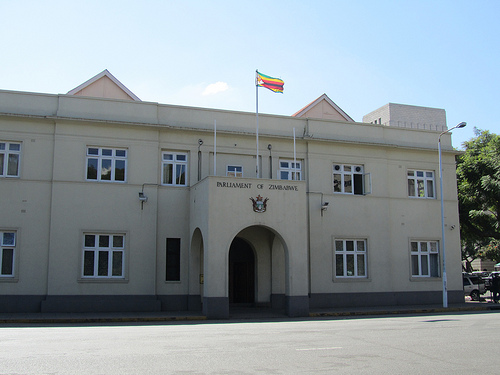
Last week, NewsDay, the privately-owned daily asked for an opinion on whether the President was legally obliged to attend question and answer sessions in Parliament, as is the case in other countries where Heads of Government are required to attend Parliament and to answer questions directly from MPs, with South Africa and the UK being notable examples. In response, I gave an account of the provisions of the Constitution of Zimbabwe and an explanation of the negotiating history of these clauses. The Newsday article can be found here https://www.newsday.co.zw/2015/02/27/mugabe-not-obliged-attend-parly-sessions/ Below is the full opinion, also carried in the media.
Presidential Question Time in the Zimbabwean Constitution
Alex T. Magaisa
The purpose of this article is to comment on the question of what might be referred to as the “Presidential Question Time” in Parliament and whether or not this is provided for in the new Constitution of Zimbabwe.
A Presidential Question Time can be defined as a session during which Members of Parliament have the opportunity to put questions to the President, which he or she is expected to answer.
When the new Constitution was being negotiated, the question as to whether or not there should be such a session was considered and debated between the negotiating parties. One side, largely the MDC parties, supported the proposition for a Presidential Question Time. However, the other side, mainly Zanu PF, were opposed to this proposition.
The proponents of this idea argued that it was necessary for purposes of accountability. If Parliament was to truly exercise its role in holding the Executive to account, then all members of the Executive, including the President should be answerable to Parliament.
The opponents were equally vociferous in their arguments. Their main contention was that the President was elected directly on a nationwide basis and he or she would be answerable directly to his or her electors and not to Parliament. They argued that it was not necessary for the President to answer to Parliament.
It has to be admitted that the arguments on either side were strong. There are jurisdictions where the head of the Executive attends and answers to Parliament, but these are where the President is not directly elected. Two examples would be South Africa and the United Kingdom, where the President and Prime Minister respectively are not directly elected but are Members of Parliament who are expected to attend and answer questions directly in Parliament.
Zimbabwe used to follow the UK system between 1980 and 1987, when it had a Westminster-type of Government headed by a Prime Minister who was head of the majority party. The Prime Minister was an MP and was expected to answer questions in Parliament. This ended when Zimbabwe introduced the Executive Presidency through Constitutional Amendment No. 7 in 1987.
The call for a Presidential Question Time in the constitution was therefore a call for the re-introduction of a feature that had once been present in our political system but had been discarded. The argument was that this detachment of the President from Parliament had not only made Parliament weaker in its role of enforcing Executive accountability but also that it had reduced transparency and accountability in Government.
Opponents of the proposition argued that the President did not have to answer to MPs and only had to answer to the people who elected him or her. This, it was argued, they could do through elections every five years. The counter-argument was that this gave the President excessive power and leeway, because that would mean going for five years without any mechanism of enforcing accountability. The argument was that it was necessary to have periodic reviews and that this could be done, among other things, through a Presidential Question Time.
It was also argued that the fact that the President was directly elected was not o itself a sufficient justification for the exemption since under the running-mates election system in s. 92, the Vice Presidents were also directly elected but were still expected under s. 107(2) to attend and answer questions from Parliament. Even if the running-mates system was suspended for ten years, the fact remained that in principle, Vice Presidents were mandatorily required to attend and answer questions in Parliament when the provision became operational, notwithstanding that they would be directly elected together with the President. There was no reasonable justification for exempting the President from the mandatory requirement to attend and answer questions in Parliament.
Opponents, however, insisted that if the Question Time was necessary for accountability, this could be done through questioning the Vice Presidents and Cabinet Ministers, and that it was not necessary to haul the President before Parliament.
My observation was that as with most issues revolving around the office of the President, the protectionist attitude was motivated by the fear of upsetting President Mugabe. This group was very protective of the office of the President and more specifically, the resistance was motivated by the desire to be seen to be protecting the person of President Mugabe. Any proposition that tried to reform the office of the President was seen as an attack on President Mugabe and this was the light in which the Presidential Question Time was seen.
Eventually, a compromise deal was struck, resulting in two provisions in the Constitution which deal with the issue of how the President and members of Cabinet are expected to respond to questions from Parliament.
Vice-Presidents and Cabinet Ministers
The first of these provisions is s. 107(2) which provides for accountability of Vice Presidents and Cabinet Ministers but it does not apply to the President. It states that:
“Every Vice-President, Minister and Deputy Minister must attend Parliament and parliamentary committees in order to answer questions concerning matters for which he or she is collectively or individually responsible”.
This is an important clause which imposes a mandatory obligation on VPs and Ministers to attend Parliament or its committees to respond to questions. They do not have the option of refusing to attend. This is why in the Clerk of Parliament was wrong to excuse Minister Saviour Kasukuwere when he was called by a Parliamentary Committee on Youth, Empowerment and Indigenisation to answer questions over the community share ownership scheme. The Minister had no right to refuse to attend merely because he was no longer the relevant Minister for that department. The requirement to attend is peremptory and should have been honoured. If he had nothing to say, then he would say so to the Committee.
The President
As we have seen, the mandatory obligation under s. 107(2) does not extend to the President. Instead, the President’s attendance at Parliament to answer questions is dealt with in s. 140(3), which provides that:
“The President may attend Parliament to answer questions on any issue as may be provided in Standing Orders”
This means that there is a possibility that the President may be called to answer questions in Parliament. However, the key feature of this provision is that the requirement to attend Parliament is discretionary on the part of the President. It states that the President “may attend Parliament”, which suggests that he or she has the option to refuse.
It is this optional effect that distinguishes the provision from the mandatory obligation on the VPs and Ministers. Therefore, whereas VPs and Minister must honour the call from Parliament, the President has an option whether or not to attend. This obviously weakens the force and effect of the provision as far as the President is concerned. It would have been stronger and better if it was a mandatory requirement.
All this means that much depends on whether the President is open-minded and democratically-minded enough to accept calls from Parliament to attend question and answer sessions. With such a President, the clause could usher in a new tradition and culture in which there is regular interaction between Parliament and the President, and in which the President responds to questions from Parliament.
Nevertheless, there is an issue that requires clarity as far as the role of Parliament in this regard is concerned. What can Parliament do to assert its power under this clause?
The provision essentially allows Parliament to set up a procedure in its standing orders and rules on calling the President to Parliament. It also means Parliament has the legal power to call the President to attend Parliament to answer questions. Whether or not the President agrees to come is an entirely separate matter which is at his or her discretion, and which like all discretionary matters, is expected to be exercised reasonably.
However, the important point here is that the fact that the President has this discretion as to whether or not to attend does not and should not stop Parliament from making a call upon him or her under this provision.
In other words, Parliament does not have to restrain itself in exercising its power under this provision. It must make the call on the President but the only thing it cannot do it to force him or her to attend. But it must, if it so wishes, exercise its power to call him and let him decide.
The implication of all this is that as part of the process of realigning laws and policies with the new Constitution, Parliament must set out a clear procedure in its Standing Rules and Orders regarding the manner of calling the President in terms of s. 140(3). Parliament should be free to make the call and should not tie its own hands because it has the power to summon the President. It’s up to the President to accept or to refuse the all.
