
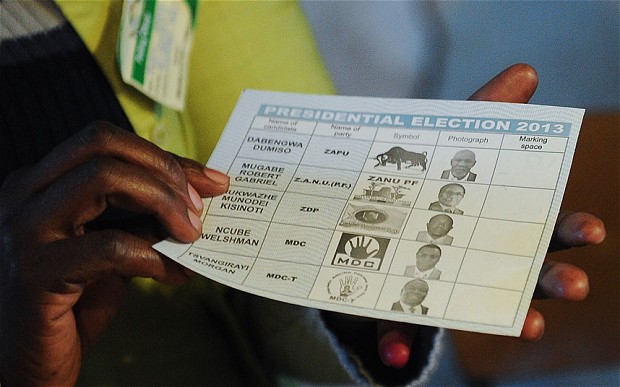
As I left the local polling station after casting my vote in the UK general elections earlier this month, I could not help but think back to July 31 2013, our own elections when I voted in Harare. There, I had the proverbial ring-side seat on the process.
Early that morning of 31 July, I had accompanied Morgan Tsvangirai, the leader of the biggest opposition party, the MDC-T, who at the time was the Prime Minister in a coalition arrangement. There were long queues at Mt Pleasant High School, where we voted. The mood was buoyant and the air was filled with high expectations. People smiled and waved. Most spoke in hushed tones, although there was an occasional shout here and there.
The process was quick and soon we were gone, to wait for the outcome. There was little trust in the process but there was a belief that finally, the will of the people would prevail. In the end, it was plain that The System had been well-prepared and would not have allowed any other outcome. What emerged the next day was a total shock and it wasn’t surprising that the outcome was heavily contested.
The observers struggled to pronounce that the elections had been free and fair, preferring a new standard, that they were free and peaceful, the latter being relevant only because previous elections had been anything but peaceful. That they were peaceful was therefore an achievement worth recording and recognising.
As I observed the election process in the UK in the weeks preceding election day on May 7, it was clear that we were still a long way from reaching the standards that these older and more mature democracies have got to.
If democracy is an evolutionary process, then ours is still in the formative stages, at least in is far as the conduct of elections is concerned. One thing that stuck out for me as a major point of difference, is the question of trust.
Not trust in the politicians, no. Distrust in politicians seems to be a universal trait. Very few people in different countries trust the tribe of politicians. The trust I refer to here is trust in the process, trust in the electoral authorities and ultimately, trust in the outcome of elections. It is trust in the electoral system.
In the UK, they have reached a point where political actors generally trust their electoral system. They may have issues over the weaknesses of the First Past the Post system of elections, with some preferring Proportional Representation, but overall, political actors and competitors trust their electoral authorities to do a professional job. You will hardly hear complaints that electoral authorities were biased or partisan. The complaints regarding the system are about the general method of electing parliamentary representatives, not the conduct of electoral authorities.
The issue of trust is critical and has an important impact in the conduct of elections.
Indelible Ink
Take the issue of indelible ink as an example. No indelible ink was used in the last British elections. You go to the polling station, announce your name to the polling officer, they find and cross it out on the voters’ register and you vote. Within a couple of minutes, you are done. You do not have to dip your little finger in a pot of indelible ink.

woman happily exhibits her inked finger as evidence of casting her vote.
This surprised me. How do they know I have already voted? Could I not just go to the next polling station and vote again? And the next? Back home, this is prevented by dipping your little finger in indelible ink. That is evidence that one has already voted and cannot vote again. This is important because people cannot be trusted. How come they do not do it here? Do they trust their people so much that indelible ink has become an anachronism?
As I observed during the July 31 elections in 2013 in Zimbabwe, the issue of indelible ink is a big political issue. In the run-up to the election day issues such as the source of the ink, its chemical composition and therefore, its quality, were key issues on the agenda. The answers were never satisfactory and the electoral authorities were evasive on the issues, which raised suspicions and mistrust.
Back in Zimbabwe, indelible ink is regarded as a useful tool to prevent double-voting. The ink has to be indelible so that cheats cannot wash it off. As it turned out, this was a major point of contention in the July 31 elections, with allegations that the ink was not, in fact, indelible, and that some people were washing it off and voting on multiple occasions at different polling stations.
But in the UK, they do not use indelible ink. It seems their system has evolved to a point where it is sufficient to rely on the voters’ honesty.

First the issue of trust is a burning issue in Zimbabwe , besides mistrust in politicians and the system there is also mistrust amongst ordinary people known as ” kuvharana” . How can we change a system we benefit from , how can even the electoral system trust the public because even when it comes to vote rigging it is the public who are instruments of it . Hence we are still far from a much more credible election process like May 7 here in UK. Second the “No reforms , No elections issue” can be applauded but don’t you think the opposition is late for that? The right time they should have advocated for this campaign was before July 31 2013. But then it is MDC-T no surprise there always shooting themselves in the foot , if you fail to push for changes in a General election what are your chances in a by election ? This is what we call on street language ” kunonokera Colgate mazino achiwora” . MDC-T need to re brand change strategy and rewrite their manifesto and lastly make sure they don’t play a game where they know the rules set are to their disadvantage for the results are total anhilation .Its high time they don’t only make history but learn from it.
You make an important point, which I had included in my piece but later edited it out to use in a future articles. This is about society’s values, the point being probably the electoral system is a reflection of the state of society? This because the culture of cheating has become endemic in our society and those who cheat their way to the top are placed on a high pedestal and lionised as heroes. I thought this point could be better made in a standalone piece and I shall address it with a piece at the weekend.
A very insightful piece as always vaMagaisa. Until we begin to trust each other again, we may as well forget about fixing our country. While we focus on economic and state institutions, we should never forget the damage done to our very social fabric. We’ve all been turned into amateur criminals, out of desperation. Curious to hear your thoughts about the endemic culture of cheating in our society, something I’ve also dealt with in this piece http://nehandaradio.com/2014/02/08/a-look-in-the-cashbert-mirror/
You’re quite right Shaun. Like I said in response to a previous comment, society itself has to look into itself. There is so much damage that has happened in the last 15 or so years that it will take more than political change to transform it. I will address this issue at the weekend.
Not sure if my previous comment was posted, so please forgive me if I appear to be spamming. My contribution was that indeed, the question of trust is a big one in our political culture, both in the state and in our institutions. ZANU PF has not only corroded our economy, but also our very social fabric. Curious to hear your thoughts about the culture of cheating, and our ambivalent attitude towards corruption. I have myself written about it here: http://nehandaradio.com/2014/02/08/a-look-in-the-cashbert-mirror/
It did thanks. Much appreciated.