
Alex T. Magaisa
President Mugabe today announced a reshuffle of his Cabinet. There are no new faces apart from Nyasha Chikwinya, who is the new Minister of Women’s Affairs, which had been vacant since the re-assignment only a few months ago of Oppah Muchinguri to the Higher Education portfolio in the aftermath of the dramatic Zanu PF Congress held in December last year.
The overriding public reaction to the reshuffle seems to be that this is no more than an exercise in re-arranging the deck chairs of a sinking ship. It’s a reflection of the failure of the reshuffle to spark any excitement among the public. But can we learn anything from the reshuffle? Is there any hope that the reshuffle will incite confidence in the markets and breathe life into a flailing economy? Who are the winners and losers in this latest reshuffle? What does it all mean within the dynamics of succession politics?
With all these questions, it is not surprising that social media has been ablaze with debate both before and after the announcement of the reshuffle today. Here we look at what we think are the most significant aspects of the reshuffle and assess briefly what they might mean in the context of our politics.
The Reassignment of Prof Moyo
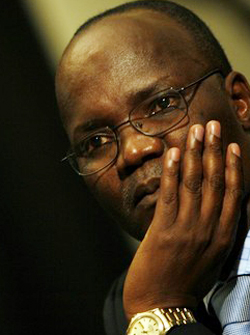
The biggest talking point is, not surprisingly, the reassignment of Prof Jonathan Moyo, from the information ministry to the higher education portfolio. Moyo is one of the big political characters on our landscape and his reassignment is a significant move politically and therefore demands scrutiny.
Only a couple of weeks ago, it looked like Moyo was a in a spot of bother when he was reportedly asked by President Mugabe to stand down from Cabinet following his victory in the Tsholotsho North by-election. The reasoning was that as he had been appointed to his post from outside Parliament, his status had since changed after his new election and it was therefore necessary for him to stand down.
For nearly two weeks, it was not clear whether he had actually lost his job permanently or whether this was just a temporary irritation, which he would soon overcome. It was also not clear whether if he did return, he would do so as information Minister or in a new portfolio. Writing two weeks ago, we speculated that it was probable that President Mugabe would use this opportunity for a reshuffle and bring back Moyo but in a different portfolio. This is what has happened. Moyo will be relieved that the doubts around his position in government have been extinguished. It is never easy to be in limbo – not knowing whether you are in or out. But for President Mugabe, this is a show of power. It was a stern reminder that he alone is the source of power and he does exactly what he wants and how he wants it. Making Moyo sweat was not just a message to Moyo, but to the rest of the Cabinet.
Moyo will also be pleased that his reassignment, confirms his strategic importance to Zanu PF. Many people speculated that he would be sacked. But this is a reaffirmation of his strategic importance to President Mugabe and Zanu PF who realise that even if he can be an occasional nuisance, they need him inside than outside. He gives a brain to a party that otherwise relies too heavily on brawn.
For some people however, the reassignment from the information ministry to higher education is something of a demotion. While higher education is obviously a bigger Ministry with greater and more substantive responsibilities, in political terms, the information ministry is perceived to be more powerful.
But people forget that this perceived power of the Ministry owes more to the personality of Moyo and his effectiveness in using the instruments at his disposal. When Moyo was given the information portfolio in 2000, he stamped his authority and personality upon the entire media landscape, and especially in the state media. In crafting AIPPA, Moyo gave Zanu PF a piece of arsenal that effectively restricted media space and conferred huge advantages against its rivals. Moyo’s methods may have been crude, unconventional and sometimes brutal, especially towards the opposition, but there was no doubt that he was thoroughly effective in executing his role for President Mugabe and Zanu PF. He earned many enemies in the process, but even his worst opponents must privately admit that he was effective in his role against them.
If Moyo made the information ministry so powerful and effective, there is no reason why he will not do the same in another portfolio, including higher education. It is, after all, the domain in which he first made his mark as an academic. It’s familiar terrain. It was his strong personality that shone through in information and it will probably do so again in higher education. Moyo might take this as a challenge to demonstrate that he has what it takes to run any department of government and make it effective. There is a lot of work to be done in the country’s higher institutions of learning which have suffered badly over the years. There are many less political institutions and initiatives he can work with to revive and promote higher education. I can see Moyo taking on this challenge to demonstrate that his talents go beyond information.
Nevertheless, losing the information portfolio will hurt, especially the circumstances in which it has been lost. He had made it his home for many years. In the matrix of power, I have previously argued that there are four principal sources of political power, and information is one of them. The others are security, finance and production. Those who can draw power from these structures command power over those who cannot. When you control the information structure, you are in charge of what information is distributed to the public, how it is distributed, how it is packaged and the intensity with which it is communicated. You control the narrative and you shape public opinion, which is very important in politics. You set the agenda and you beat opponents with it. Moyo knew this very well and he used the media very effectively for the cause of his political masters. This effectiveness was most recently evident in the campaign against former Vice President Joice Mujuru and her allies. The state media assault against them was relentless and brutal. Anyone who wielded such power would miss it. Moyo will miss it, too.
There is also another important dimension which might be a greater source of injury. The political rumour-mill had long suggested that Vice President Emmerson Mnangagwa and his allies were not comfortable with Moyo’s control and use of the information portfolio. Moyo himself had sniped back at suggestions that Mnangagwa’s allies were not pleased with him. Mnangagwa’s allies must work on getting their man electable, he had snarled back on social media.
His BBC HARDtalk interview, which gave a distinct impression of a lack of enthusiasm for a Mnangagwa presidency may have proved too much for Mnangagwa’s allies. It was rumoured that they wanted him as far away from the information portfolio as possible as they saw that role as toxic in the context of their man’s presidential ambitions. If Moyo had used state media so effectively as he had done against Mujuru, what could stop him from doing the same against Mnangagwa? It is against this background, which is true, would mean the reassignment of Moyo from the information Ministry would be regarded a victory in campaign by Mnangagwa’s allies to get him moved. If Moyo was aware of these efforts, then the circumstance of his removal will probably hurt him.
This might be made worse by the fact that information portfolio is now under the temporary charge of Prisca Mupfumira, the Labour and Social Welfare Minister, who is reported to be a close associate of Mnangagwa. If this true, this effectively means that Mnangagwa’s camp are now in control of the information ministry and therefore all of state media. But they would be mistaken to think the information Ministry is powerful simply because it controls state media. Its effectiveness under Moyo was down to his personality and style and going forward they will have to work just as hard and skilfully as he did if it is to be of any use to them.
Naturally, with these changes at the top, there will be changes in the state media in the foreseeable future. History suggests that new Ministers do make changes to institutions under their charge when they take up office. Moyo himself did the same when he came in two years ago. He established his own team which worked very well for him. The departure of Moyo from the Ministry must be very ominous for the team. They too may be ‘promoted’ leaving room for a new team. Those now in charge of state media will find it hard to trust them and they will want to bring in their own people.
As for Moyo himself, he may sulk as he leaves the power of state media, but he will briskly pick himself up and go out to prove his talents at higher education. Previous ministers there have been quiet, dour and ineffective. Moyo will stamp his personality. He will engage his old colleagues in academia and possibly try to reawaken sleeping giants like the University of Zimbabwe, NUST and reinvigorate the relatively new universities including his hometown institution, Lupane State University. He might even enjoy not having the responsibility of cleaning up after his old boss and government and instead use higher education to traverse the country and build his own image as a national leader with a developmental focus.
Saviour Kasukuwere: the mini-President
The other big mover is Saviour Kasukuwere, who moves from Environment, Water and Natural Resources to Local Government, which unbeknown to most people, is a very powerful and influential Ministry. It is the Ministry that gave previous incumbent Ignatius Chombo immense power, influence and wealth. As Local Government Minister, you control local authorities – both rural and urban, you control the critical traditional institutions led by Chiefs and Headmen in the rural areas.
All this means the Local Government Minister is in fact a mini-President, being in charge of the local government structures in the entire country. Kasukuwere is also vocal and has a big presence, which he ensured was felt when he was at the Youth and Indigenisation Ministry, which has since taken a much lower and dour profile since his departure. He will do the same at Local Government.
Although the Local Government Minister’s powers have been somewhat curtailed under the new Constitution, there is still neither the appetite nor the resources to implement devolution. It seems clear that Kasukuwere has been given this important portfolio to dovetail neatly with his role as Political Commissar of Zanu PF, all of this with an eye towards the 2018 elections. A political commissar’s role is essentially to organise the party and to mobile the structures and members. Zanu PF has traditionally made use of local government structures, including the District Administrators, Chiefs and Headman in rural areas, for purposes of mobilisation and organising the party. Now with one man wearing both hats as Political Commissar and the Local Government Minister, this will essentially blur the distinction between party and the state.
As Minister and Commissar, Kasukuwere will be able to move seamlessly from one zone to the other and in that process, will be able to pursue party business whilst wearing the hat of Government Minister, giving it all a veil of legitimacy. This is about Zanu PF consolidating its power and control across the country, merging the state structures and party structures for maximum effectiveness. This means when the opposition talks of electoral reforms, they must realise that in fact President Mugabe and Zanu PF are consolidating the structures that give them an advantage and no reforms of the Electoral Act will affect these structures.
In terms of internal power politics, if it is true that Kasukuwere is on the opposite side of Mnangagwa’s presidential ambitions, then giving him this powerful portfolio might be a way of counter-balancing the two factions, having already removed Moyo taken from information.
Chombo
Finally, Chombo’s move to Home Affairs gives him power over a key part of the security structure, which is an important source of power. Chombo might be hurt by the loss of the powerful Local Government Ministry which had given him so much power and wealth over the years. But as the Secretary for Administration in Zanu PF and having control of Home Affairs, he might see that as good enough compensation for his loss. Politically, having the party’s chief administrator in charge of the police is a statement of power and a strategy which aims to enforce the stamp of the party on this critical state institution.
Meanwhile the movement of Kembo Mohadi from Home Affairs to State Security has some significance regarding changes that are taking place within Zanu PF. Home Affairs has for a long time been occupied by former members of PF Zapu. Dumiso Dabengwa held the post for many years, before John Nkomo took over. Later Mohadi took on the role. It appeared there was an unwritten understanding or a convention within Zanu PF that the Home Affairs portfolio would go to former PF Zapu members. Indeed, when the GNU was negotiated, one of the reasons used for Zanu PF to retain a stake in it was that this was a position traditionally reserved for PF Zapu members since the Unity Accord. Now however, this pattern has been broken by Chombo’s appointment. What does it mean for Zanu PF’s commitment to the arrangements with former PF Zapu members? Or was it never a convention at all, but a cnsicidence that only former PF Zapu members had been appointed to that portfolio? It does seem that this signals some major changes. Maybe the old Zanu PF does not see displeasing their former PF Zapu members as a threat? Maybe this is a message that the game has changed and even the co-Vice Presidency may not have to be shared in the old ways? Time will tell.
Will the new appointments make a difference to the economy? Will the markets react positively to the news? Is there anything to give foreign investors renewed confidence in the country? Sadly, there is little to give confidence. It’s the same people being moved from one chair to the other. We know who they are, their politics and the likely direction they will take. In short, there is nothing new.
As I wrote elsewhere earlier today, what Zimbabwe really needs is a reshuffle of the economy. But no-one is up for that challenge. The band did play on as the Titanic sank. Here again, we see nothing but the conductor rearranging members of the band. The tune has not changed. They will play on as the ship sinks deeper and deeper until they are heard no more.
waMagaisa
Strictly not to be published without the author’s permission. [email protected]
