
Alex T. Magaisa
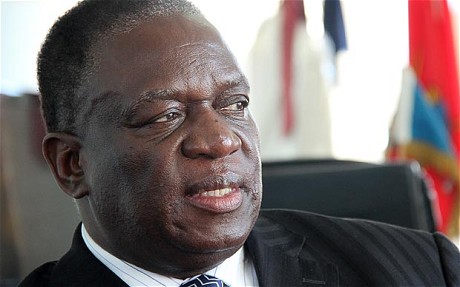
Last week, Vice President Emmerson Mnangagwa was in China on an official visit. We learnt that the visit was at the specific invitation of the Chinese Vice President, Li Yuanchao. It is unclear whether the invitation was to the Vice Presidency of Zimbabwe generally and Mnangagwa happened to be selected to represent the two Vice Presidents or it was specifically directed to Mnangagwa only.
The likelihood is that it was the latter. Of the Zanu and Zapu elements that constitute the post-1987 Zanu PF, it is the former that has historically had closer relations to China while the latter had greater proximity to the Russians. Given that background, it wouldn’t be surprising if the invitation was specifically to Mnangagwa ahead of his former Zapu counterpart. If that is the case, it would be an indication of whom the Chinese fancy as the most likely between the two Vice Presidents to succeed Mugabe.
While VP Mphoko has rightly protested at being referred to as the second VP, because such a hierarchy does not exist in the present constitutional set-up, the political reality is that his counterpart, Mnangagwa enjoys precedence over him. And the Chinese seem to have that figured out, hence their call to Mnangagwa. Also, if Simon Khaya Moyo had not flirted with Gamatox, in all likelihood, he, not Mphoko, would be Vice President. Mphoko won’t like it but that is the politics at play.
Mnangagwa’s visit is significant given China’s growing influence in Zimbabwe. It comes at a time when the Europeans have been rather desperately trying to patch up their fractured relationship with Zimbabwe. The Afrobarometer Survey at the end of 2014 showed that a majority of Zimbabweans (68%) believe that China’s economic activities have some/a lot of influence on Zimbabwe’s economy. 48% thought the influence is somewhat/a lot positive while 31% thought it was somewhat/a lot negative.
And last year, Zimbabwe and China signed what Government and state media have often described as “mega-deals” covering various areas. People are asking what happened to those deals but Government says they won’t bear fruit overnight. The fact is China, more than Europe is having a greater influence on Zimbabwe – economically and also, it seems, politically.
More significantly, this visit to China by Mnangagwa, following on from President Mugabe’s visit last year, is like the heir-apparent being introduced to the Chinese political establishment. It’s an indication that China is probably placing its bets on Mnangagwa being next leader of Zimbabwe after President Mugabe. They have not always got it right. Back in 2012, the Chinese were not certain about the future of Zimbabwe. They realised they had to hedge their bets by playing it safe with Morgan Tsvangirai and the MDC, who were in a coalition with Zanu PF.
It was against this background that they invited Tsvangirai to China when he was Prime Minister. Just in case he won in the future election and became President. They had to hedge their bets. The invitation did not please Zanu PF and predictably, state media sought to downplay the visit, describing it as a low-key visit at the invitation of the Beijing Municipality. The truth is the visit had been initiated by the Chinese Ambassador and Tsvangirai had met with the Chinese Prime Minister Wen Jiabao.
But writing on 5th June 2012, The Herald was keen to pour cold water on the visit with the headline, “Chinese Government never invited Tsvangirai”. It was an exercise in denialism. It hurt that China seemed to be cosying up to the political rival. They forgot that the Chinese were like any businessperson and they would look after their interests first.
For their part, the Chinese were simply hedging their bets in case Tsvangirai, who was supposed to be closer to the West became leader of Zimbabwe. China has huge business interests in Zimbabwe and like any investor, will do anything to protect its interests. Cementing its links with the man who is potentially the next leader of Zimbabwe is an important part of that protective mechanism, which would explain Mnangagwa’s latest visit.
While he was in China Mnangagwa gave a rare interview to CCTV China’s international television network (https://www.youtube.com/watch?v=Irj0HVsESag ). At half an hour long, it is probably the longest interview of significance that Mnangagwa has ever given to date. The interview was as interesting as it was revealing. The symbolism of Mnangagwa giving such a long and in-depth interview to the Chinese channel ahead of the usual Western networks cannot go unnoticed. Mnangagwa is showing he is comfortable with the Chinese.
And of course the interview itself was safe territory. There were no risks, no blind spots. The interviewer was kind and gentle. The questions were easy and largely straight-forward. When he answered, Mnangagwa was allowed to meander and go round in circles. There was no aggression; no effort to challenge and expose – very unlike CNN or BBC’s HARDtalk, to which Professor Jonathan Moyo had given a controversial interview a couple of months back. The contrast could not have been more different, as was the symbolism. Moyo had given an interview to a Western channel, but Mnangagwa had looked East.
In the HARDtalk interview, Moyo had been subjected to some hard and sensitive subjects – the politics of succession, the removal of VP Mujuru, the struggling economy, the disappearance of democracy activist Itai Dzamara, Gukurahundi atrocities. By contrast, in the CCTV interview, Mnangagwa only had to talk about economic issues, sanctions and how grateful Zimbabwe was to the Chinese. Nothing about the politics, nothing about succession, nothing about what happened to Mujuru, nothing about past human rights violations and certainly nothing about the Dzamara disappearance. There was nothing sensitive, nothing hard, certainly nothing to cause discomfort
And this stark contrast in the two interviews was symbolic of the very different approaches between the West and China towards African countries in general, and Zimbabwe in particular. The West tends to come with many questions on various subjects, including democracy and human rights. The Chinese by contrast come focused on the economic front and will not say anything about the politics and human rights. To African countries and to Zimbabwe in particular, the West interferes, but China doesn’t. It isn’t hard to see why China has become the partner of preference in most African countries. It’s not hard to see why Mnangagwa was relaxed and comfortable in the CCTV interview. These were friends talking to each other, having a friendly chat.
But it also showed the extent to which in the bid to escape the fangs of the West, Zimbabwe under the current leadership is prepared to give itself away to China rather cheaply. At times the Vice President seemed excessive in his praise and adoration of China. While he spoke of self-respect and guarding independence, the irony was that he seemed to be submitting excessively to the Chinese, as if they were the new saviours.
But the Chinese, just like the West are in it for the money; for their own economic interest. They are not doing us any favours. Their primary concern is their interests. While Zimbabwe has the right to work with whoever they want, including China, we must disabuse ourselves of the notion that the Chinese are with us on grounds of benevolence. They are in business and we must approach the relationship in a business-like manner. We do not have to be grateful to them.
At least Mnangagwa was honest over the state of the economy, admitting that Zimbabwe is about two decades behind in terms of development. He admitted that industrial capacity is at its lowest. But of course all this is blamed on the narrative of sanctions, which is only a part of the problem in the bigger scheme of things.
The influence of China is also evident in that China has now sent ‘experts’ to sit in the Office of the President and Cabinet, where they will guide Zimbabwe. We can expect more and more Chinese influence seeing as it is that they now occupy space in the political engine-room. The irony is a few thousand miles away in East Africa, one of Zimbabwe’s most successful businessmen, Strive Masiyiwa, was talking business with Kenya’s President Uhuru Kenyatta. Zimbabwe has many sons and daughters like him. The government only needs to engage these people and doesn’t have to rely on Chinese expertise. For a country that prides itself as an exponent of indigenisation, it is odd that it has to hire foreign experts to help steer it in the right direction when it can so easily turn to its huge pool of human capital. It’s like a new colonialism, characterised by self-loathing and a preference for the foreign actors, seen as the saviour.
Another revelation worth noting are the close links between Zanu PF and the Communist Party of China and the material support that the former will receive from the latter. Mnangagwa spoke of the support that the Chinese have agreed to render to Zanu PF in various areas, including building schools for training. It would be interesting to see how this within the legal framework in which political party financing from external sources is prohibited.
Overall, Mnangagwa’s China visit has important implications. The biggest foreign player in Zimbabwe at the moment is showing its hand. This was an introduction to the Chinese political establishment of the man who is most likely to take over after Mugabe. In a way, it’s an exercise in political orientation. The well-choreographed and kind CCTV interview also introduced Mnangagwa to the global stage. It was an opportunity for a soft-landing. For the first time the world, and even most Zimbabweans, got a rare glimpse of the man in some depth.
It’s a pity the interrogation wasn’t as robust but this was not the stage for a thorough inquisition. It was designed to showcase the man and the statesman. We can’t say we known more about Mnangagwa than we did before, but the Chinese political establishment will certainly have got a better understanding of the man they are likely to be doing business with in future. And just like his old boss, he is likely to get their favour – not because he is an excellent man but because he will safeguard their interests.
Not to be reproduced without permission.
You can view Mnangagwa’s interview here https://www.youtube.com/watch?v=Irj0HVsESag
