
Alex T. Magaisa
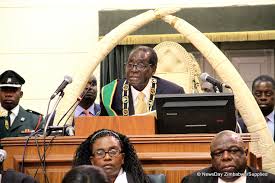
After President Mugabe delivered his State of the Nation Address (SONA) to Parliament on Tuesday, which by most observers’ accounts seems to have been rather underwhelming, opposition legislator Nelson Chamisa moved a motion calling for the President to return to answer questions from the house. Zanu PF MPs objected to the motion. However, the Speaker of Parliament, Adv. Jacob Mudenda, agreed that the motion was proper and constitutional.
Chamisa’s motion was correct and the Speaker was also correct to permit it. This is an issue that I have previously covered on this blog and in NewsDay, the private daily, in February this year
In an article entitled “Presidential Question-Time in the Zimbabwean Constitution”, I explained that it was perfectly constitutional for Parliament to call the President to answer questions from members but that the President had a discretion to agree or decline to attend. (see: /presidential-question-time-in-the-zimbabwean-constitution/.
I am pleased to note that Chamisa has taken up this issue and that the Speaker has adopted the right path on this matter.
A Presidential Question Time allows members to put questions to the President and to get amplification and clarification on particular issues. It also allows the President an opportunity to explain issues in more detail.
In the case of the SONA, which is a constitutional obligation under s. 140(4) of the constitution, it is not only proper but appropriate that the President’s address be subjected to scrutiny by the citizens through the agency of their parliamentary representatives. This is particularly important where the President is not a member of Parliament. A Presidential Question Time after the SONA would offer an opportunity to analyse and critique the important address to the nation.
Besides, it would be an important tradition which allows the people, through their parliamentary representatives, to interact with and engage the President beyond election periods.
However, I’m not surprised that Zanu PF MPs objected to Chamisa’s motion. During the constitution-making process, Zanu PF’s representatives were equally unhappy with this clause when it was first proposed in the negotiations. Their default mode was to oppose anything that would put the President to the test. For them, it was tantamount to embarrassing President Mugabe, even though the constitution was not being made for him alone but for all persons who would occupy presidential office. Any proposed reforms regarding the office of the President were seen as an attack on their boss, President Mugabe. I observed that among the Zanu PF representatives, the fear of upsetting President Mugabe was ever dominant in the discourse around constitutional reforms.
They also argued that since the President was elected independently on a nationwide basis, he had no obligation to answer to Parliament. This was a weak argument as the constitution already made all organs of the state, including the office of the President, accountable to Parliament.
It was this opposition to the clause, however, that left it in its present, rather diluted state, which on the one hand permits Parliament to call the President to answer questions, but on the other hand also gives the President an option to decline to attend.
The provision that deals with the Presidential Question-Time issue is s. 140(3). It provides that:
“The President may attend Parliament to answer questions on any issue as may be provided in Standing Orders”
This means the President may be called by Parliament to answer questions. Nevertheless, the requirement on the President to attend Parliament for this purpose is discretionary. This is because the provision says the President “may attend Parliament”, suggesting that he or she has the option to refuse.
This is what distinguishes the provision from the requirement on the Vice Presidents and Cabinet Ministers to attend Parliament for the same purpose, which is mandatory in terms of s. 107(2). This provision states that:
“Every Vice-President, Minister and Deputy Minister must attend Parliament and parliamentary committees in order to answer questions concerning matters for which he or she is collectively or individually responsible”.
Unlike the President, a Vice President or a Cabinet Minister does not have the option of refusing to attend Parliament or any of its committees when called to answer questions. It is because of this clause that the former Clerk of Parliament, Austin Zvoma, was wrong last year to excuse Saviour Kasukuwere, a Cabinet Minister, when he refused to attend a session of the Parliamentary Committee on Youth, Empowerment and Indigenisation where they wanted to question him on the community share ownership schemes during his tenure as Indigenisation Minister. The Minister had no right to refuse to attend that session and it’s a good thing that this was later corrected this year when he was called again by the same committee.
The fact that the President has the option to decline is a weakness of the provision. Much will depend on the attitude of the President and whether he possesses the democratic inclinations to submit himself to the call of Parliament.
The Speaker is therefore absolutely correct to permit Chamisa’s motion. Whether or not the President agrees to attend Parliament to answer questions remains to be seen. It’s at his discretion but the expectation is that it would be used reasonably. He is not obliged to attend but if he does agree, he would set an important precedent and usher in a tradition and culture of accountability to Parliament. As Prime Minister and head of government between 1980-87, he used to attend Parliament and answer questions, so it wouldn’t be something new to President Mugabe or our political system. But the fact that they got rid of it also suggests that he is not keen on it.
The fact that the President has discretion to attend does not and should not stop Parliament from making a call upon him to attend Parliament to answer questions. Parliament cannot force him to attend but it should not restrain itself from exercising its right to call him.
Will President Mugabe heed the call and attend? I doubt it. Not after the booing and heckling from the opposition MPs when he presented the SONA on Tuesday. His advisors will most likely advise him not to take the risk. In any event, he is not used to being questioned by anyone, let alone in a public forum like Parliament.
But in the event that he does spring a surprise and agrees to attend, it will probably be on condition that he will only respond to written questions submitted in advance and that there will be no impromptu questions from members of the house.
I really hope I am wrong but I suspect President Mugabe will decline the invitation.
waMagaisa
Editors: As with all articles on this website, this is not to be used without author’s permission and only then, to be used with following acknowledgement: This article was first published on www.alexmagaisa.com Follow on Twitter @wamagaisa Contact at [email protected]

I am with you on this one Dr , particularly on hedging the bet that The President may decline to come and answer questions in the August House. Mugabe does not want to be embarrassed. Remember the last time that happened in Maputo prior to that July 31 election date proclamation? During SONA he was subjected to the same humiliating jeers . They were from the opposition benches.For him every action has an equal and opposite reaction. Will he come ?